
What is Tridosha Theory in Ayurveda?
Introduction
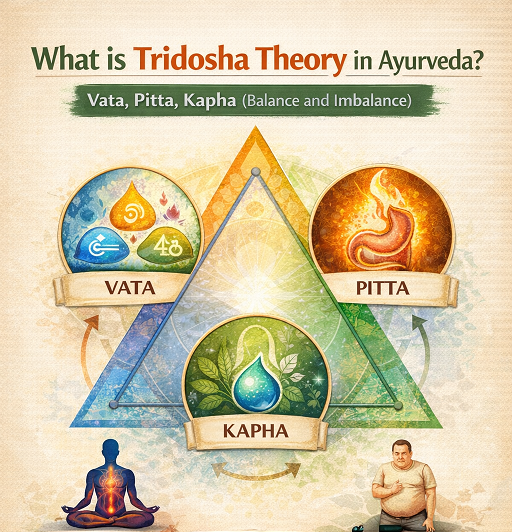
The Tridosha Theory is one of the most fundamental principles of Ayurveda. It explains how the human body functions and how health and disease arise. According to Ayurveda, the body is governed by three primary biological energies known as Doshas.
These three Doshas are:
-
Vata
-
Pitta
-
Kapha
The balance of these three doshas maintains health, while their imbalance leads to disease. Understanding the Tridosha theory is essential for Ayurvedic diagnosis, treatment, diet planning, and lifestyle management.
For students of Ayurveda, especially BAMS students, Tridosha theory forms the foundation of Kriya Sharir (Ayurvedic physiology).
Meaning of Dosha in Ayurveda
The Sanskrit word Dosha comes from the root “Dush”, which means that which vitiates or disturbs.
In Ayurveda, Doshas are functional principles that regulate all physiological and psychological activities in the body.
When balanced, Doshas maintain health. When aggravated or depleted, they disturb the body's equilibrium and produce disease.
Origin of Tridosha
The Tridosha concept originates from the Panchamahabhuta theory, which states that the entire universe, including the human body, is composed of five fundamental elements:
-
Prithvi (Earth)
-
Jala (Water)
-
Tejas (Fire)
-
Vayu (Air)
-
Akasha (Space)
These five elements combine to form the three Doshas:
| Dosha | Elements |
|---|---|
| Vata | Air + Space |
| Pitta | Fire + Water |
| Kapha | Earth + Water |
Thus, the Tridosha represents the functional expression of the Panchamahabhutas within the body.
The Three Doshas in Ayurveda
1. Vata Dosha
Vata is considered the most important dosha because it controls movement in the body.
Main Qualities of Vata
-
Dry
-
Light
-
Cold
-
Rough
-
Mobile
Functions of Vata
-
Movement of muscles and joints
-
Nervous system activity
-
Respiration
-
Circulation
-
Speech and communication
-
Elimination of waste
Because Vata governs movement, it also regulates the functions of Pitta and Kapha.
2. Pitta Dosha
Pitta represents the principle of transformation and metabolism.
Main Qualities of Pitta
-
Hot
-
Sharp
-
Light
-
Slightly oily
-
Spreading
Functions of Pitta
-
Digestion of food
-
Metabolism and enzyme activity
-
Body temperature regulation
-
Vision
-
Intelligence and understanding
-
Hormonal regulation
Pitta is mainly associated with digestive and metabolic processes.
3. Kapha Dosha
Kapha represents the principle of stability and structure.
Main Qualities of Kapha
-
Heavy
-
Cold
-
Stable
-
Smooth
-
Oily
Functions of Kapha
-
Structural integrity of tissues
-
Lubrication of joints
-
Immunity and resistance to disease
-
Growth and nourishment of tissues
-
Emotional calmness and stability
Kapha provides strength and endurance to the body.
Importance of Balance of Doshas
According to Ayurveda, health is defined as the state of equilibrium of Doshas, Dhatus, and Malas.
When the Doshas remain in their normal state:
-
Digestion is proper
-
Tissues are nourished
-
Waste products are eliminated efficiently
-
Mind remains calm and stable
However, when Doshas become imbalanced due to improper diet, lifestyle, or environmental factors, diseases develop.
Dosha Imbalance and Disease
Each dosha can undergo three conditions:
-
Vriddhi (Increase)
-
Kshaya (Decrease)
-
Prakopa (Aggravation)
Examples:
-
Excess Vata may cause anxiety, constipation, or joint pain
-
Excess Pitta may cause acidity, inflammation, or irritability
-
Excess Kapha may cause obesity, lethargy, or congestion
Ayurvedic treatments aim to restore the balance of doshas.
Role of Tridosha in Diagnosis
Ayurvedic physicians evaluate the state of Doshas while diagnosing a patient.
Diagnosis includes:
-
Pulse examination (Nadi Pariksha)
-
Observation of symptoms
-
Examination of tongue, eyes, and skin
-
Analysis of digestion and elimination
Treatment is then designed to pacify the aggravated Dosha.
Tridosha and Individual Constitution (Prakriti)
Every individual is born with a unique Prakriti, or constitutional type, determined by the dominance of one or more doshas.
Common types include:
-
Vata Prakriti
-
Pitta Prakriti
-
Kapha Prakriti
-
Vata-Pitta
-
Pitta-Kapha
-
Vata-Kapha
Prakriti influences a person's:
-
Physical characteristics
-
Mental tendencies
-
Disease susceptibility
-
Dietary needs
Understanding Prakriti helps in personalized healthcare in Ayurveda.
Relevance of Tridosha Theory in Modern Health
Even today, Tridosha theory is highly relevant for:
-
Preventive healthcare
-
Personalized nutrition
-
Lifestyle management
-
Yoga therapy
-
Holistic medicine
Many researchers attempt to correlate Doshas with modern physiological systems such as metabolism, immunity, and nervous regulation.
Importance for BAMS Students
For BAMS students, Tridosha theory is crucial because:
-
It forms the foundation of Ayurvedic physiology (Kriya Sharir)
-
It helps understand pathogenesis (Samprapti)
-
It guides treatment principles in Kayachikitsa
-
It is essential for Panchakarma therapy
Without understanding Tridosha theory, it is difficult to practice Ayurveda effectively.
Conclusion
The Tridosha theory is the cornerstone of Ayurveda, explaining how the body functions and how diseases develop. The three Doshas—Vata, Pitta, and Kapha—govern all physiological processes in the body.
Maintaining the balance of these Doshas is essential for health, while their imbalance leads to disease.
For students and practitioners of Ayurveda, mastering the concept of Tridosha is essential for accurate diagnosis, effective treatment, and maintaining overall well-being.