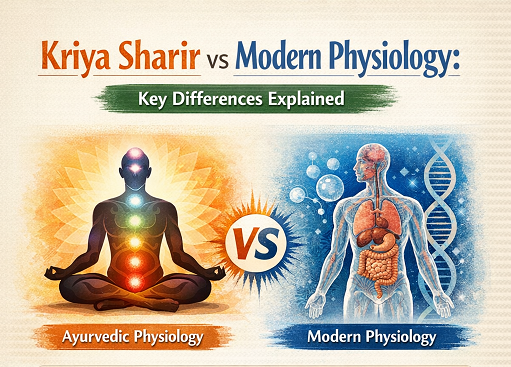

Kriya Sharir vs Modern Physiology: Key Differences Explained
Introduction
Understanding the functioning of the human body has been the central aim of medical sciences across civilizations. In Ayurveda, the science that explains body functions is known as Kriya Sharir, whereas in modern medicine it is called Physiology.
Both disciplines aim to explain how the human body works, but their philosophical foundations, concepts, and approaches differ significantly.
While modern physiology focuses on organs, tissues, and biochemical mechanisms, Kriya Sharir explains body functions through concepts such as Dosha, Dhatu, Agni, and Srotas.
This article explores the key differences between Kriya Sharir and modern physiology, helping BAMS students understand how the two systems interpret bodily functions.
What is Kriya Sharir?
Kriya Sharir is the branch of Ayurveda that deals with the functional aspects of the human body according to Ayurvedic principles.
The word Kriya means action or function, and Sharir means body. Thus, Kriya Sharir refers to the study of bodily functions.
It explains how physiological processes occur through the interaction of:
-
Tridosha (Vata, Pitta, Kapha)
-
Agni (digestive and metabolic fire)
-
Dhatus (body tissues)
-
Malas (waste products)
-
Srotas (body channels)
Kriya Sharir focuses on maintaining balance within the body, which is considered essential for health.
What is Modern Physiology?
Modern physiology is the branch of biomedical science that studies the mechanical, physical, and biochemical functions of living organisms.
It examines how cells, tissues, organs, and systems interact to sustain life.
Key areas of modern physiology include:
-
Cardiovascular physiology
-
Respiratory physiology
-
Digestive physiology
-
Endocrine physiology
-
Neurophysiology
Modern physiology explains body functions primarily through biochemical reactions, hormones, enzymes, and cellular mechanisms.
Philosophical Foundation
One of the major differences between Kriya Sharir and modern physiology lies in their philosophical foundations.
Ayurveda is based on Samkhya philosophy and the Panchamahabhuta theory, which explains the body as a combination of five fundamental elements:
-
Prithvi (earth)
-
Jala (water)
-
Tejas (fire)
-
Vayu (air)
-
Akasha (space)
From these elements arise the three Doshas, which regulate all physiological processes.
Modern physiology, on the other hand, is based on biological sciences, chemistry, and physics, focusing on measurable physical and biochemical processes.
Core Principles of Body Function
In Kriya Sharir
The functioning of the body is governed by Tridosha:
Vata
-
Responsible for movement
-
Controls nervous system activity, respiration, and circulation
Pitta
-
Responsible for metabolism and transformation
-
Governs digestion, enzyme activity, and body temperature
Kapha
-
Responsible for structure and stability
-
Maintains lubrication, immunity, and tissue integrity
Health exists when these three doshas remain in equilibrium.
In Modern Physiology
Modern physiology explains body functions through organ systems and cellular processes, such as:
-
Nervous system regulation
-
Hormonal control
-
Enzymatic reactions
-
Cellular metabolism
-
Homeostasis
The body maintains stability through feedback mechanisms and biochemical regulation.
Concept of Digestion and Metabolism
In Kriya Sharir
Digestion and metabolism are explained through the concept of Agni.
Agni is responsible for:
-
Digesting food
-
Absorbing nutrients
-
Transforming substances into body tissues
Types of Agni include:
-
Jatharagni – digestive fire in the stomach and intestines
-
Dhatvagni – metabolic activity within tissues
-
Bhutagni – elemental transformation of nutrients
A balanced Agni leads to good health, whereas impaired Agni leads to disease.
In Modern Physiology
Modern physiology explains digestion through:
-
Enzymatic breakdown of food
-
Absorption in the intestines
-
Metabolic pathways such as glycolysis and the Krebs cycle
-
Hormonal regulation
Metabolism is studied through biochemical reactions occurring inside cells.
Concept of Body Tissues
In Kriya Sharir
Ayurveda describes seven Dhatus that sustain the body:
-
Rasa (plasma and nutrient fluid)
-
Rakta (blood)
-
Mamsa (muscle tissue)
-
Meda (fat tissue)
-
Asthi (bone tissue)
-
Majja (bone marrow and nervous tissue)
-
Shukra (reproductive tissue)
These tissues are formed sequentially through Dhatu metabolism.
In Modern Physiology
Modern physiology studies tissues through histology and cellular biology, identifying four major tissue types:
-
Epithelial tissue
-
Connective tissue
-
Muscle tissue
-
Nervous tissue
Each tissue has specialized cells performing specific functions.
Concept of Waste Products
In Kriya Sharir
Ayurveda describes three main Malas (waste products):
-
Purisha – feces
-
Mutra – urine
-
Sweda – sweat
Proper elimination of these wastes is necessary for maintaining health.
In Modern Physiology
Waste products are explained through excretory processes, including:
-
Urinary excretion via kidneys
-
Carbon dioxide elimination through lungs
-
Sweat secretion via sweat glands
These processes help maintain internal balance (homeostasis).
Key Differences Between Kriya Sharir and Modern Physiology
| Aspect | Kriya Sharir | Modern Physiology |
|---|---|---|
| Medical System | Ayurveda | Modern Medicine |
| Approach | Holistic | Analytical |
| Functional Units | Dosha, Dhatu, Agni | Cells, tissues, organs |
| Health Concept | Balance of Doshas | Homeostasis |
| Metabolism | Agni | Enzymes and biochemical reactions |
| Disease Cause | Dosha imbalance | Pathological processes |
Integration of Kriya Sharir and Modern Physiology
In recent years, there has been increasing interest in integrating Ayurvedic concepts with modern biomedical sciences.
Many researchers are attempting to correlate:
-
Vata with nervous system functions
-
Pitta with metabolic and enzymatic activity
-
Kapha with structural and immune functions
Such integration may help develop holistic healthcare models combining traditional wisdom with modern scientific understanding.
Importance for BAMS Students
For BAMS students, understanding the difference between Kriya Sharir and modern physiology is important because:
-
It strengthens the conceptual foundation of Ayurveda
-
Helps in comparative understanding during exams
-
Improves clinical interpretation of diseases
-
Bridges the gap between Ayurvedic and modern medical sciences
A strong understanding of both systems allows physicians to adopt a comprehensive approach to patient care.
Conclusion
Kriya Sharir and modern physiology both aim to explain the functioning of the human body, but they approach it from different perspectives.
Kriya Sharir explains physiological processes through Dosha, Dhatu, Agni, and Srotas, emphasizing balance and holistic functioning. Modern physiology explains body functions through cells, organs, and biochemical mechanisms.
Together, these two perspectives provide a broader understanding of human physiology, making integrative medicine a promising field for the future.