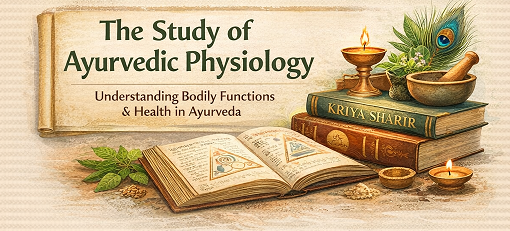
What is Kriya Sharir in Ayurveda? Complete Guide for BAMS Students
Introduction
Kriya Sharir is one of the most important subjects in Ayurveda that deals with the functional aspects of the human body. While Rachana Sharir describes the anatomical structure of the body, Kriya Sharir explains how the body functions according to Ayurvedic principles.
In simple terms, Kriya Sharir can be understood as Ayurvedic physiology, which studies the mechanisms that maintain life, health, and balance in the body.
For BAMS students, understanding Kriya Sharir is essential because it forms the foundation for diagnosis, treatment, and understanding disease processes in Ayurveda.
This article explains the core concepts of Kriya Sharir, its importance in Ayurveda, and its relevance for students and practitioners.
Meaning of Kriya Sharir
The word Kriya Sharir is composed of two Sanskrit terms:
-
Kriya – Action or function
-
Sharir – Body
Therefore, Kriya Sharir means the study of bodily functions.
In Ayurveda, it includes the study of:
-
Dosha physiology
-
Dhatu metabolism
-
Agni and digestion
-
Mala formation and excretion
-
Body channels (Srotas)
-
Mind-body interaction
Thus, Kriya Sharir explains how life processes occur within the body according to Ayurvedic principles.
Definition of Kriya Sharir in Ayurveda
According to Ayurvedic philosophy:
“Sharira Kriya Vijnanam Kriya Shariram.”
This means the scientific understanding of the functions of the human body is called Kriya Sharir.
Kriya Sharir describes the dynamic activities of the body that sustain life, such as:
-
Respiration
-
Circulation
-
Digestion
-
Metabolism
-
Reproduction
-
Mental functions
Importance of Kriya Sharir in Ayurveda
Kriya Sharir plays a crucial role in understanding the principles of health and disease in Ayurveda.
1. Foundation for Ayurvedic Diagnosis
Ayurvedic diagnosis depends largely on understanding the functional imbalance of Doshas, Agni, and Dhatus.
2. Basis for Understanding Disease
Every disease in Ayurveda arises from functional disturbances before structural changes occur.
3. Essential for Treatment Planning
Proper knowledge of Kriya Sharir helps physicians decide:
-
Appropriate therapies
-
Panchakarma procedures
-
Dietary recommendations
-
Lifestyle modifications
4. Bridge Between Ayurveda and Modern Physiology
Kriya Sharir also helps correlate Ayurvedic concepts with modern physiological understanding.
Major Concepts Studied in Kriya Sharir
1. Tridosha Theory
The concept of Tridosha is the cornerstone of Ayurvedic physiology.
The three doshas are:
-
Vata – Principle of movement
-
Pitta – Principle of transformation
-
Kapha – Principle of stability and structure
These doshas regulate all physiological processes in the body.
When balanced, they maintain health; when disturbed, they cause disease.
2. Agni (Digestive Fire)
Agni represents the metabolic and digestive processes in the body.
It is responsible for:
-
Digestion of food
-
Absorption of nutrients
-
Transformation of substances into body tissues
Types of Agni include:
-
Jatharagni
-
Dhatvagni
-
Bhutagni
Healthy Agni is essential for maintaining proper physiology.
3. Dhatu (Body Tissues)
Dhatus are the structural and functional tissues of the body.
There are seven dhatus in Ayurveda:
-
Rasa
-
Rakta
-
Mamsa
-
Meda
-
Asthi
-
Majja
-
Shukra
Each dhatu performs specific functions and supports the next dhatu in sequence.
4. Mala (Waste Products)
Malas are the waste products of metabolism.
The main malas are:
-
Purisha (feces)
-
Mutra (urine)
-
Sweda (sweat)
Proper elimination of malas is necessary for maintaining health.
5. Srotas (Body Channels)
Srotas are the transport channels of the body responsible for the movement of nutrients, waste, and energy.
Examples include:
-
Pranavaha Srotas
-
Annavaha Srotas
-
Rasavaha Srotas
Blockage of srotas leads to disease.
Difference Between Kriya Sharir and Modern Physiology
| Aspect | Kriya Sharir | Modern Physiology |
|---|---|---|
| Basis | Dosha, Dhatu, Agni | Organs, cells, tissues |
| Approach | Holistic | Mechanistic |
| Focus | Balance and harmony | Biological mechanisms |
| Goal | Maintaining health and preventing disease | Understanding body functions |
Despite differences, both systems aim to understand how the human body functions.
Importance of Kriya Sharir for BAMS Students
For BAMS students, Kriya Sharir is important because:
-
It forms the foundation for clinical subjects like Kayachikitsa
-
It helps in understanding disease pathogenesis (Samprapti)
-
It is essential for Panchakarma therapies
-
It improves clinical diagnosis
Mastering Kriya Sharir allows students to think like an Ayurvedic physician rather than memorizing information.
Relevance of Kriya Sharir in Modern Health Sciences
The principles of Kriya Sharir are increasingly being studied in areas such as:
-
Integrative medicine
-
Preventive healthcare
-
Yoga physiology
-
Lifestyle medicine
Concepts like metabolism, immunity, and gut health can be better understood through Ayurvedic physiology.
Conclusion
Kriya Sharir forms the physiological foundation of Ayurveda. It explains how the human body functions through the interaction of Doshas, Dhatus, Agni, and Srotas.
For BAMS students and Ayurveda practitioners, a deep understanding of Kriya Sharir is essential for diagnosing diseases, planning treatments, and maintaining health.
By studying Kriya Sharir, one gains insight into the dynamic processes that sustain life and balance in the human body.